For INFLAMMATORY ARTHRITIS, Ginger Concentrate has a long history of use as a powerful anti-inflammatory spanning Chinese, Japanese, and Indian medical traditions since the 16th century. Modern research confirms that ginger brings pain relief, improves joint mobility, and enhances circulation. It also reduces cartilage destruction and joint temperature, and eases swelling and stiffness for patients with inflammatory arthritis, including rheumatoid and psoriatic varieties. Studies show that daily ginger consumption for periods ranging from 3 months to 2 years provides significant clinical improvement in 75 to 95% of patients, supporting traditional wisdom.
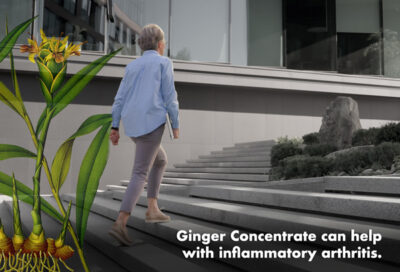 Ginger works in several ways: It protects joints by direct antioxidant actions and reduces the formation of mediators that trigger inflammation in tissues. Ginger promotes joint healing because it contains proteases with actions resembling bromelain that clear out debris resulting from inflammation and tissue damage. Early evidence even suggests that ginger impedes the genes that code for inflammatory signals, reducing inflammation at the source and offering a deep level of healing.
What is ginger?
Ginger is a small, leafy plant that originated in China, other parts of Asia, West Africa, the Caribbean and India; the medicinal part of the plant that is consumed is the root. Known formally as Zingiber officinalis in botanical medicine, ginger has been used medicinally for thousands of years in eastern and Ayurvedic medicine as a natural pain reliever and anti-inflammatory food and as a spice.
Ginger’s pungent flavor is due to volatile oils in the root, including a mixture of shogaols and gingerols. Gingerols have analgesic, sedative, digestive, antipyretic, anti-inflammatory and antibacterial properties. Among these many actions, it is the analgesic and anti-inflammatory qualities of ginger that are so valuable to those who suffer from inflammatory arthritis.
Ginger root is a powerful natural medicine, which can actually be as effective as non-steroidal anti-inflammatories (NSAIDs), but it needs to be strong enough. We recommend standardized concentrates that provide 20 to 25 mg of ginger’s active compounds including gingerols and shogaols per dose.
Ginger fights inflammation
Many people have relied on traditional non-steroidal anti-inflammatory drugs (NSAIDs) to find relief from the pain of inflammation. These drugs work by shutting down one major inflammation pathway in the body, the pro-inflammatory enzyme cyclooxygenase, or COX, thereby suppressing prostaglandin synthesis.
Prostaglandins and leukotrienes are hormone-like substances released from cell membranes. Amongst many other actions, they regulate inflammation and the body’s healing response. The types of prostaglandins made from a 20-carbon fatty acid named arachidonic acid will trigger inflammation. The conversion of arachidonic acid into prostaglandin is catalyzed by enzymes like cyclooxygenase (COX), which are blocked by ginger.
In a healthy system, prostaglandins are produced in response to injury or infection, leading to redness, swelling, and pain associated with the healing process. With inflammatory joint disease and other disorders, excess amounts of prostaglandins cause needless inflammation that becomes destructive.
Like NSAIDs, ginger can also block cyclooxygenase, reducing inflammatory types of prostaglandins to relieve pain. However, ginger has an extra benefit over NSAIDs: it also inhibits leukotriene release by blocking the enzyme 5-lipoxygenase. Leukotrienes are small biological mediators that trigger inflammation, swelling, and pain.
Ginger is proving to be a game-changer because of its unique, dual action beyond anything offered by conventional medicine. It blocks two major metabolic pathways that drive pain and swelling in the body. This ability to modulate both major inflammatory pathways — the prostaglandins and the leukotrienes — distinguishes ginger from NSAIDs. By fighting on two fronts instead of just one like NSAIDs, ginger can offer broader, more complete relief from both pain and swelling.
Overall, ginger appears to be more effective with fewer side effects than NSAIDs, because it can block both COX and 5-lipoxygenase enzymes. In fact, research conducted at Odense University in Denmark has suggested that after 3 months of daily use, ginger can provide better improvements in pain and swelling than achieved by some NSAIDs.
Even better, multiple cell culture studies show that ginger has anti-inflammatory action by stopping the release from macrophages of powerful inflammatory biochemicals like Interleukin-1 (IL-1), Tumor Necrosis Factor-alpha (TNF-alpha), and Interleukin-8 (IL-8), all of which are proteins that fuel the fire of arthritis and are usually elevated with arthritic inflammation. The active ingredients in ginger are precise and multi-functional. These compounds do not just mask pain; they target the core mechanisms of the disease and can interrupt the complex chemical signals that tell the body to keep churning out inflammation.
Many constituents of ginger have been identified for their medicinal properties. This means that ginger formulas can be optimized for their effects on specific biomarkers of inflammation. The compound 6-gingerol blocks NF-kappa B and protein kinase C signaling and inhibits cytokine release from macrophages. Gingerdione and 6-shogaol inhibit prostaglandin E2 formation. Zingerone, a constituent of ginger extract, can inhibit genes involved in the inflammatory response, including genes encoding cytokines, chemokines, and the inducible enzyme cyclooxygenase-2. This discovery shows us that ginger modulates chronic inflammation pathways through genetic influences.
Ginger is a powerful antioxidant
Protective compounds in ginger have potent antioxidant actions, shielding joints and connective tissues from free radical damage. Beyond that, ginger stimulates the body’s innate antioxidants to further boost protection from oxidative damage.
Oxygen free radicals are byproducts of the body’s normal metabolism and energy production, and result from exposure to air pollutants, drugs, and industrial chemicals, as well as UV light, pollution, smoking, and poor diet. Most of these oxygen radicals are safely contained within the membrane folds of mitochondria, but about 2 percent escape, generating toxins that endanger the entire cell. Free radicals have unpaired electrons, and roam the body seeking molecules to attach to, generating toxins that endanger tissues. This is called oxidative stress or free radical damage, and it fuels inflammation and injures joint tissues.
The destructive and self-perpetuating cycle of chronic inflammatory arthritis is largely driven by oxidative stress. This results from the overproduction of unstable free radicals, such as Reactive Oxygen Species (ROS), by immune cells like neutrophils and macrophages within the joints. These free radicals relentlessly attack and damage healthy joint tissue, including cartilage, proteins, and DNA. When the body’s inherent defenses are overwhelmed, this oxidative stress directly contributes to joint degradation and the painful, persistent swelling characteristic of the condition.
Antioxidants “loan out” extra particles or molecules to stabilize oxygen free radicals. Usually, antioxidants are natural substances that shield tissues from scavenging free radicals, reduce oxidative cell injury, and quench harmful peroxides that damage lipids.
A crucial aspect of ginger’s effectiveness is its direct counteraction of the oxidative damage driving the inflammatory loop. Ginger’s antioxidant effect breaks down existing inflammation and acidity. Its active constituents neutralize the ROS that sustain joint destruction. The phenolic compounds within ginger, particularly gingerols, shogaols, and gingerdiones, directly scavenge damaging free radicals by donating electrons or hydrogen atoms, preventing cellular and tissue damage.
Moreover, ginger helps the body fight back internally by maintaining cellular integrity, notably by reducing lipid peroxidation — the process by which free radicals damage the fatty acids in cell membranes, making them unstable. By shielding cell membranes from oxidative injury, ginger keeps the cells healthy.
Even better, ginger has the great ability to encourage the body to produce its own natural antioxidant enzymes, building a stronger, more lasting defense against future damage. Beyond these direct actions, ginger also strengthens the body’s natural defense system by upregulating endogenous antioxidant enzymes, such as Superoxide Dismutase (SOD), Catalase (CAT), and Glutathione Peroxidase (GPx), allowing the body to sustain a higher, more durable defense against oxidative damage.
Ginger’s comprehensive actions addressing both inflammation and the underlying oxidative stress position it as a promising, multi-target natural therapy for inflammatory arthritis.
Fibrin breakdown
Ginger also promotes fibrin breakdown, reducing the risk of tiny blood clots and their possible contribution to inflammation. Our circulatory system directs blood to the extremities via arteries, and veins return blood back to the heart. Veins work like a one-way street using a system of valves to prevent blood from flowing back in the other direction.
Some people have a reduced ability to clear their own fibrin, a connective tissue protein that can be deposited around blood vessels, making the surrounding skin hard and lumpy and increasing the risk of tiny clots and connective tissue inflammation.
Fibrin is a strong insoluble protein produced by our body in response to bleeding. Whenever tissue is damaged, fibrinogen found in blood plasma is converted into fibrin molecules by a clotting enzyme called thrombin. These molecules combine together to form long fibrous chains which entangle the red blood cells and platelets at a wound, later resulting in a spongy mass that contracts to form a blood clot. Ginger has been shown to break down excess fibrin around blood vessels. By allowing blood vessels to expand, ginger also improves nutrient flow around joints and connective tissues and speeds removal of metabolic waste.
Our patients’ experience with ginger concentrate
In our clinic, the treatment goals for inflammatory arthritis are to reduce joint inflammation and pain, maximize joint function, improve range of motion, enhance each patient’s comfort with increased activity, and to prevent future joint destruction and deformity. Our patients taking a ginger concentrate with 20 to 25 mg of the key active compounds, including gingerols and shogaols, 2 to 3 times daily for 3 to 6 months, tell us they feel less pain, swelling and stiffness, better range of motion, and better energy as their pain level drops and sleep improves. Some patients can reduce their doses of steroids or NSAIDs or other medications and become free of side effects.
Many clinical studies have confirmed the efficacy of ginger, especially at 5% of active ingredients in doses of 500 to 2,000 mg total per day. Pain measurement typically decreases by 2.3 to 2.6 points on a 10-point scale. This dose of 20 to 25 mg of ginger’s active constituents can sometimes be as effective as NSAID drugs.⁵
Ginger offers a powerful and comprehensive strategy against inflammatory arthritis. Its analgesic properties reduce the perception of pain, while its molecular and genetic actions dismantle the cycle of inflammation at its core. This unique multi-target approach improves our patients’ joint mobility and lessens their suffering from inflammatory conditions, without gastrointestinal side effects, improving their quality of life.
Recommendation: Ginger root concentrate, standardized to 5% of ginger’s key active compounds including gingerols and shogaols, with a total daily dose of 500 to 1,000 mg. This amounts to 25 to 50 mg or more of the active constituents. Take 1 to 3 times daily, between meals, or as directed by your healthcare provider.
References
- Srivastava KC, et al. Ginger (Zingiber officinale) in rheumatism and musculoskeletal disorders. Medical Hypotheses Volume 39, Issue 4 (1992): 342–348.
- Grzanna R, Lindmark L, Frondoza CG. Ginger — an herbal medicinal product with broad anti-inflammatory actions. Journal of Medicinal Food. July 2005, 8(2): 125–132.
- Farooqi R, Maryam H, Jaffar HM, Malik T. Therapeutic Potential of Fox Nut (Euryale ferox) in Osteoarthritis Management: A Nutraceutical Approach. Food Reviews International 0:0, pages 1–27.
- Adham J. Herbal Remedies as Adjunct Therapies for Rheumatoid Arthritis: Focus on Ginger: A Review. Open J Orthop Rheumatol. 2025;10(1):021–025.
- Daily JW, Zhang X, Kim DS, et al. Efficacy of Ginger for Alleviating the Symptoms of Primary Dysmenorrhea: A Systematic Review and Meta-analysis of Randomized Clinical Trials. Pain Med. 2015;16(12):2243–55.